Griha Pravesh AI Photo Editing Prompts: 7 Copy-Paste Gemini & ChatGPT Prompts
For me, no photo in a family’s life feels quite like the first one at the door of a new home. The marigold toran is still fresh, the rangoli is still bright on the threshold, someone is holding the brass kalash with both hands, and everyone is smiling because years of saving, searching and waiting have finally turned into a set of keys. Griha Pravesh is that moment — and it photographs beautifully.
Griha Pravesh comes from the Sanskrit words griha, meaning house, and pravesh, meaning entry. It is the Hindu housewarming ceremony performed when a family moves into a new home for the first time, and it is believed to purify the house, invite prosperity and seek divine blessings for everyone who will live there. The ritual is described in ancient texts such as the Matsya Purana, and it is still performed in homes across India today — in flats in Mumbai and Delhi, in independent houses in Lucknow and Patna, and in new villas in Hyderabad and Bengaluru.
The ceremony has a shape I have seen again and again: the entrance is decorated with a toran of mango leaves and marigolds and a rangoli at the threshold, a coconut is broken at the door to remove obstacles, the lady of the house steps in first with her right foot, carrying the kalash — a brass or copper pot filled with water, mango leaves and a coconut on top — because her entry symbolises Goddess Lakshmi entering the home. Then comes the Vastu Shanti homa, the fire ritual, and the milk is boiled in the new kitchen until it overflows, a sign of abundance, before being turned into kheer or payasam and shared as prasad.
In this article, you will get 7 ready-to-use Griha Pravesh AI photo editing prompts for couples, families, the puja, the housewarming party and the first rituals in the new kitchen. Upload your photo, copy one prompt, and paste it into Gemini or ChatGPT. Every prompt keeps your face recognisable and focuses on realistic light and real ceremony moments — not a cartoon filter.
These prompts are for personal photos of yourself, your partner, your family, and your friends. Use only your own photos, or family photos with their permission. Do not present an AI-edited photo as a real ritual moment you did not actually perform. An AI-edited photo is a lovely way to celebrate your new home, but it is not a replacement for the real morning at your own front door.
Quick Pick: Which Griha Pravesh Prompt Should You Use?
| Prompt | Best for | Mood |
|---|---|---|
| 1. Kalash and Toran Entrance Portrait | Couple, first entry | Joyful, auspicious |
| 2. Coconut Breaking at the Threshold | The threshold moment | Traditional, warm |
| 3. Vastu Shanti Puja and Havan Portrait | Puja, havan ceremony | Serene, devotional |
| 4. Housewarming Family Portrait | Family, group photos | Warm, together |
| 5. Housewarming Invitation Card Photo | Invitations, WhatsApp cards | Elegant, celebratory |
| 6. Evening Diya-Lit New Home Exterior | Evening, house exterior | Glowing, magical |
| 7. First Milk Boiling in the New Kitchen | Kitchen ritual, first cooking | Sweet, homely |
How to Use These Prompts
- Open Gemini or ChatGPT and upload a clear photo of yourself, face well lit and facing the camera.
- Copy one prompt below in full, including the face-preservation line.
- Paste it with your photo and let the AI generate the edit.
- If a result changes your face too much, run the same prompt again with a different photo, or add “keep my face exactly as in the uploaded photo”.
- Do not upload anyone else’s photo without their permission, and do not create a photo that pretends to be a real ritual moment you did not attend.
For the best results, start with a daylight photo, without sunglasses or a heavy filter. A sharp, front-facing photo gives you a much more natural result than a dark or blurry one.
7 Griha Pravesh AI Photo Editing Prompts
1. Kalash and Toran Entrance Portrait
The photo every family wants from Griha Pravesh: the couple at the decorated front door, the kalash in hand, the marigold toran overhead and the rangoli underfoot. This is the first entry — the muhurat moment — and it is the one that ends up framed in the living room.
AI Prompt:
Edit our uploaded couple photo into a realistic Griha Pravesh entrance portrait. Preserve both faces, facial features, skin tones, and identities exactly, without merging faces. Place us standing at the flower-decorated entrance of our new home, holding a brass kalash with mango leaves and a coconut on top, a marigold and mango-leaf toran garland hanging above the doorway and a colourful rangoli on the threshold. Dress us in festive traditional attire, with warm golden morning light and the new home softly visible behind us. Use realistic fabric, flower and skin texture, natural poses, and a vertical 9:16 composition. Make it look like a candid professional photograph, not an illustration. No text, no logo, no watermark.
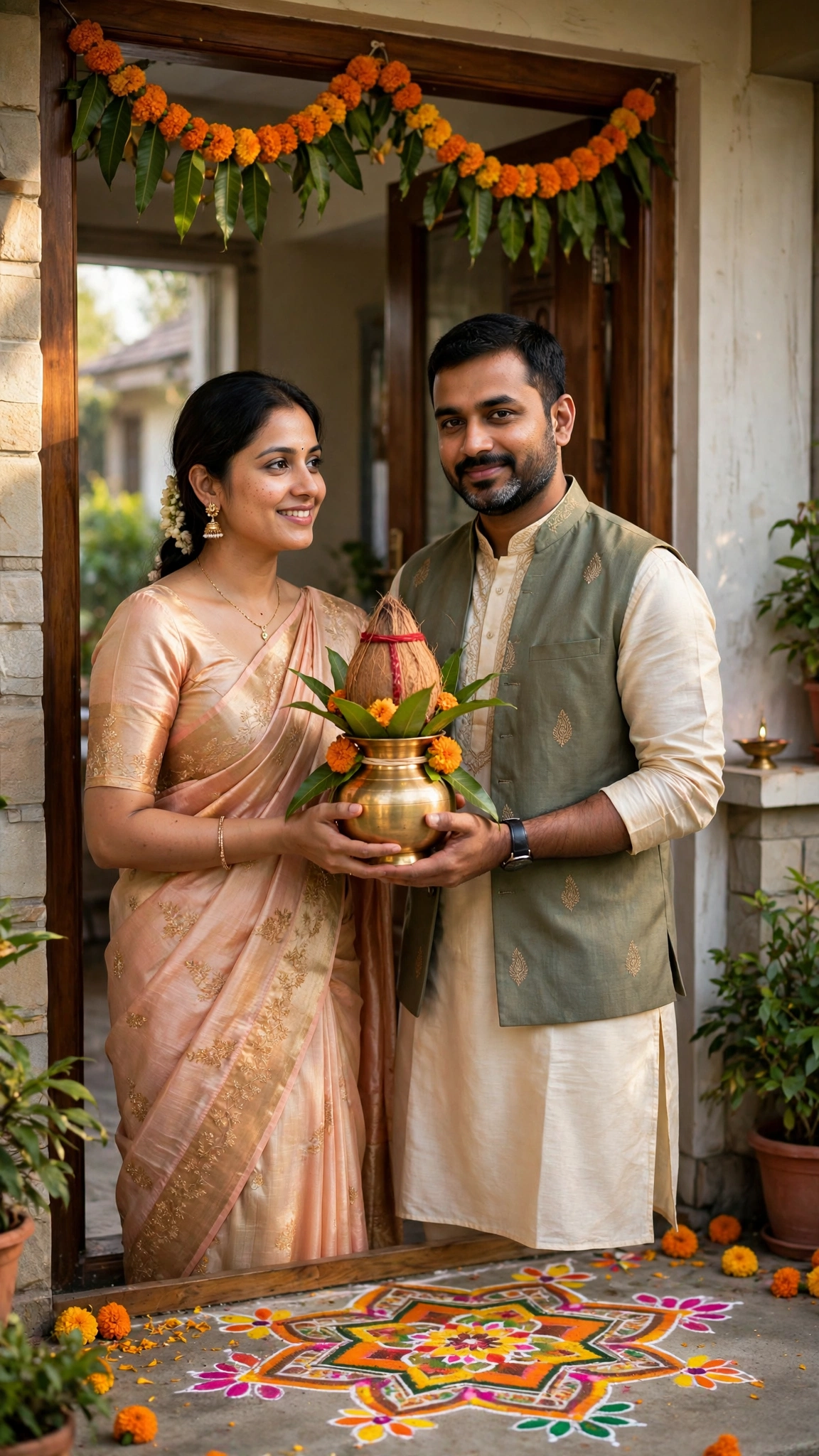
Best for: Couple DPs, first-entry photos and the framed photo in the new home.
Customize it: If the kalash hides one face, ask for it held lower, at waist height, so both faces stay clear of the coconut and mango leaves.
2. Coconut Breaking at the Threshold Moment
Before anyone steps inside, a coconut is broken at the threshold — in North Indian tradition, to remove obstacles before the family enters. It is a small moment, over in seconds, and almost nobody gets a good photo of it. This prompt recreates it.
AI Prompt:
Edit my uploaded photo into a realistic Griha Pravesh coconut-breaking portrait. Preserve my face, facial features, skin tone, and identity exactly. Place me in a festive saree at the threshold of a new home’s front door, breaking a coconut on the doorstep, with a colourful rangoli on the floor, a marigold toran above the door, and family members smiling softly behind me. Use warm daylight, realistic coconut, flower and skin texture, and a vertical 9:16 composition. Make it look like a candid professional photograph, not an illustration. No text, no logo, no watermark.
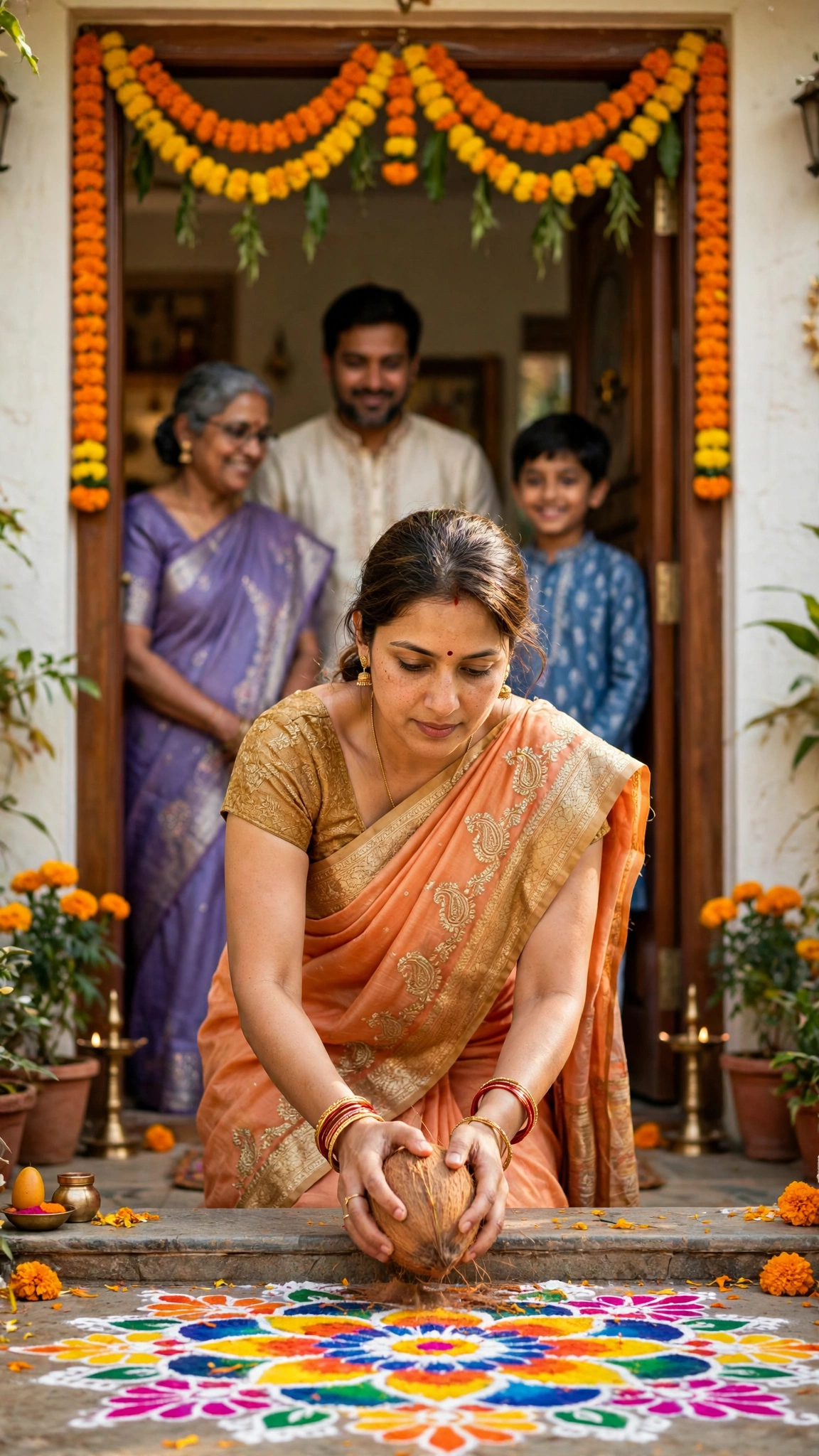
Best for: The threshold ritual and traditional ceremony posts.
Customize it: In South Indian tradition the coconut is often placed at the threshold rather than broken — if that is your custom, change “breaking a coconut” to “placing a coconut at the threshold” in the prompt.
3. Vastu Shanti Puja and Havan Portrait
The heart of the ceremony is the Vastu Shanti homa, the fire ritual where the priest offers ghee and samagri into the havan kund while chanting mantras, honouring Vastu Purusha, the deity of the house. It is the calmest, most devotional part of the day — and the hardest to photograph well, because everyone is seated and the light is low.
AI Prompt:
Edit our uploaded family photo into a realistic Griha Pravesh Vastu Shanti puja portrait. Preserve every face, facial feature, skin tone, and identity exactly, without merging faces. Place our family seated around a small havan kund fire inside our new home during the Vastu Shanti puja, a priest chanting mantras beside us, a brass kalash and flowers nearby, with warm firelight glowing softly on our faces. Use realistic fire, fabric and skin texture, natural seated poses, and a vertical 9:16 composition. Make it look like a candid professional photograph, not an illustration. No text, no logo, no watermark.
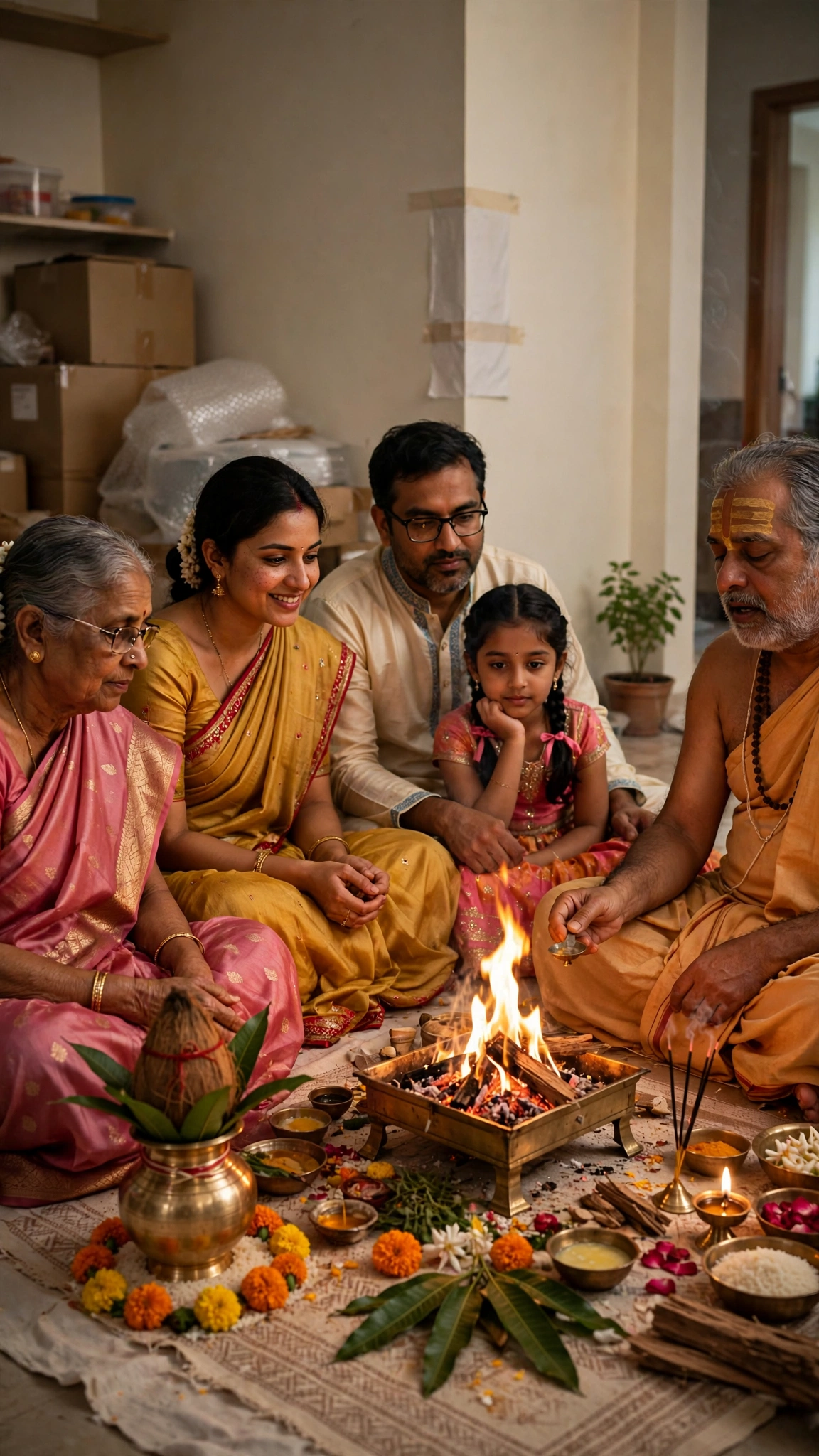
Best for: Puja photos, havan ceremony posts and devotional DPs.
Customize it: Firelight is tricky for AI — if the flames look painted or the faces look too orange, regenerate and ask for “softer firelight, faces clearly lit”.
4. Housewarming Family Portrait in the New Living Room
After the puja, the house opens up: relatives arrive, someone brings sweets, the children run through rooms that still smell of fresh paint, and the whole family gathers in the living room for the first group photo in the new house. This prompt is for that photo.
AI Prompt:
Edit our uploaded family photo into a realistic Griha Pravesh housewarming family portrait. Preserve every face, facial feature, skin tone, and identity exactly, without merging faces. Place our family together in the bright new living room of our home, dressed in festive traditional clothes, with marigold flower garlands, mango-leaf toran decorations and glowing brass diyas around us, smiling warmly at the camera. Use warm inviting light, realistic fabric, flower and skin texture, natural poses, and a vertical 9:16 composition. Make it look like a candid professional photograph, not an illustration. No text, no logo, no watermark.
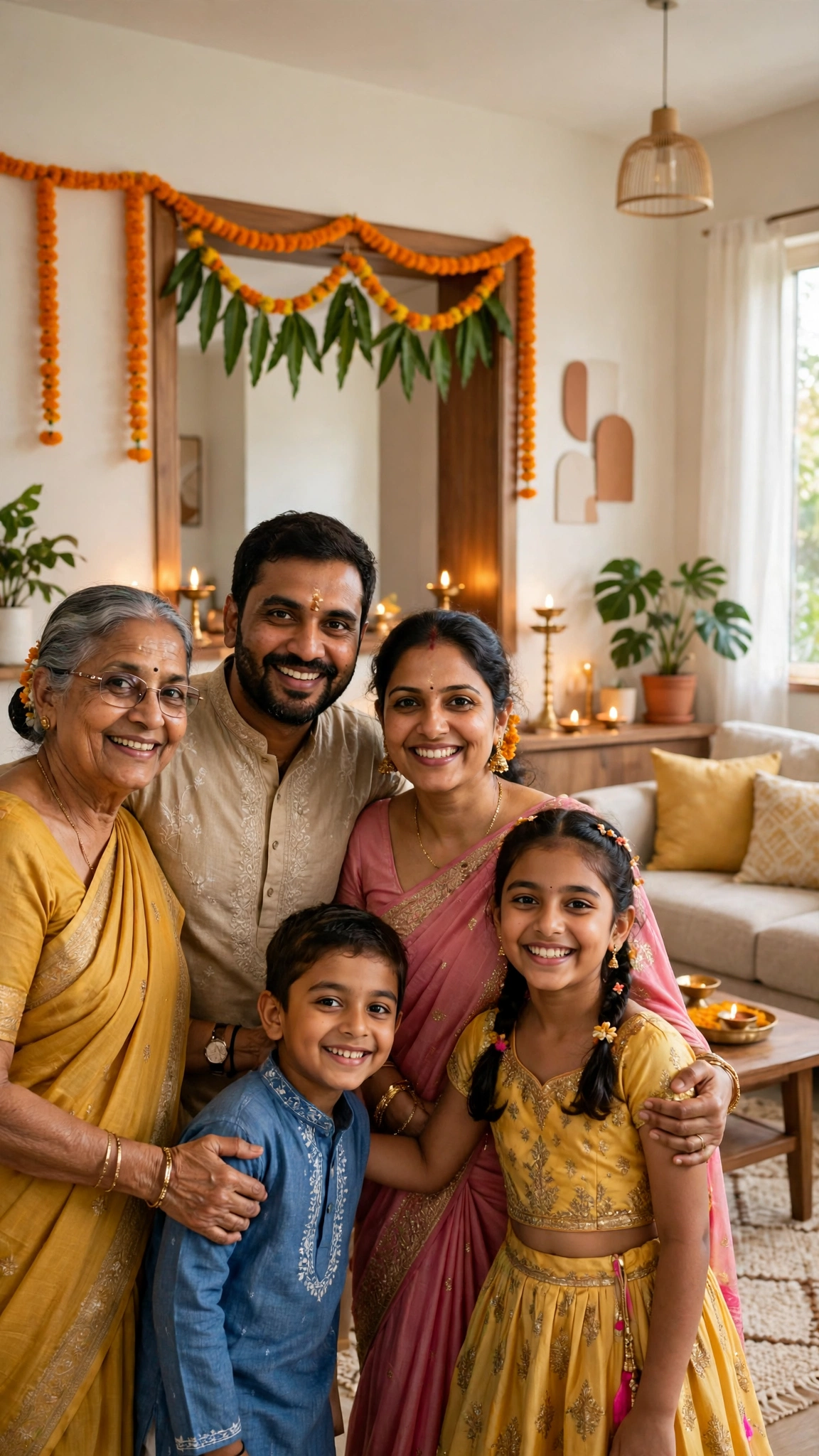
Best for: Family posts, group DPs and the photo you send to relatives who could not attend.
Customize it: Use a family photo where every face is clearly visible; the AI needs each face to keep them distinct, and a group crop where someone is half-hidden will not work as well.
5. Housewarming Invitation Card Style Photo
A Griha Pravesh invitation usually goes out on WhatsApp a week or two before the day — and a photo of the couple at their new front door makes the card feel personal instead of generic. This prompt is designed for that upright, card-ready portrait.
AI Prompt:
Edit our uploaded couple photo into a realistic Griha Pravesh housewarming invitation-style portrait. Preserve both faces, facial features, skin tones, and identities exactly, without merging faces. Place us standing together in elegant festive traditional attire in front of our beautifully decorated new home entrance, with marigold garlands, a mango-leaf toran and a brass kalash beside the door, posed like a housewarming invitation photo, with warm golden evening light and space around us. Use realistic fabric, flower and skin texture, natural poses, and a vertical 9:16 composition. Make it look like a candid professional photograph, not an illustration. No text, no logo, no watermark.
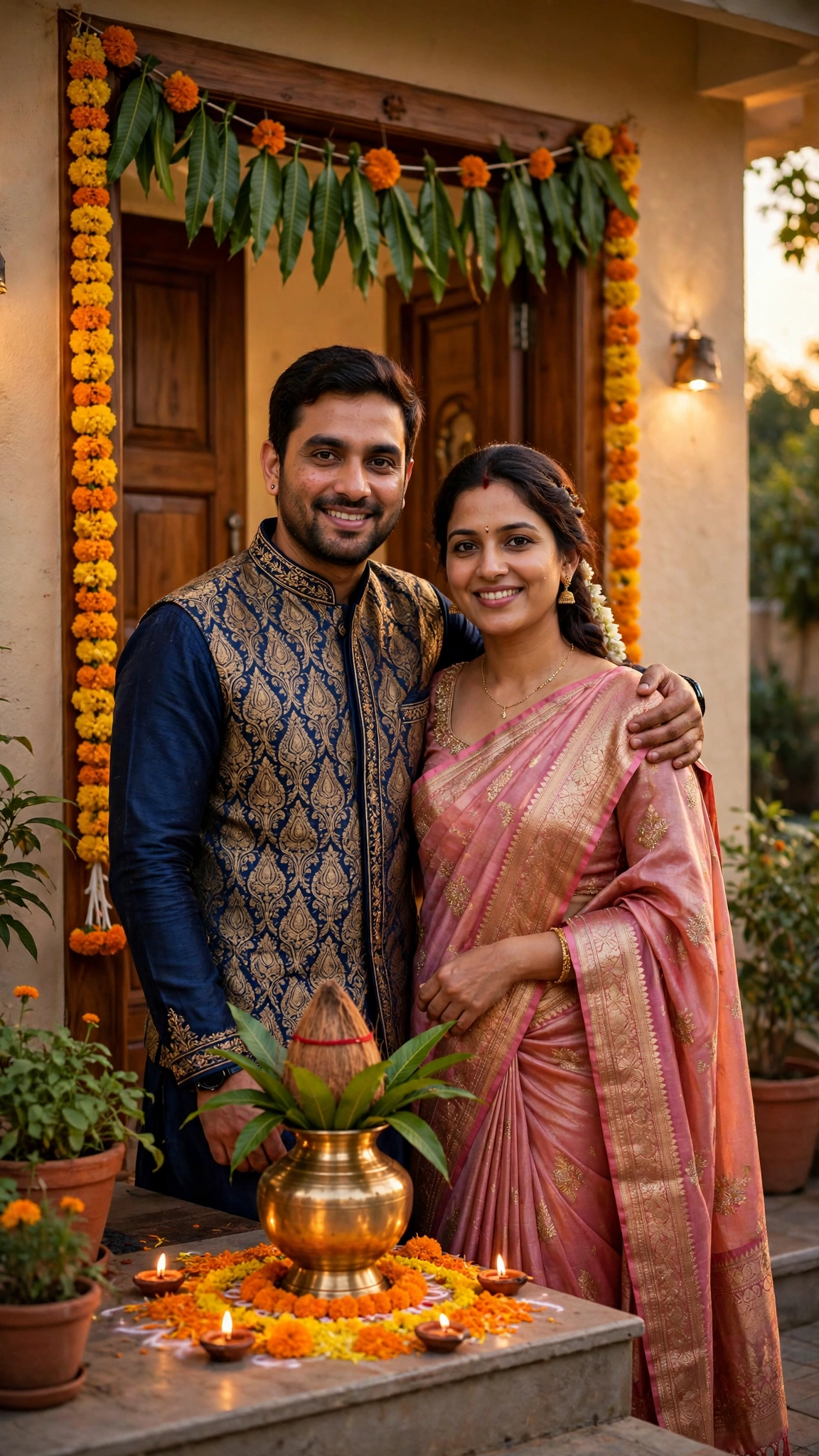
Best for: WhatsApp invitations, housewarming cards and announcement posts.
Customize it: Keep the couple slightly to one side of the frame if you plan to add invitation text yourself afterwards — and add the text in your phone’s editor, not in the AI prompt, so the wording stays correct.
6. Evening Diya-Lit New Home Exterior
My favourite Griha Pravesh photo is the one taken after sunset: the house lit up with rows of clay diyas along the steps and windows, the toran still on the door, the family standing outside in the glow. It is the photo that says “we live here now” better than any other.
AI Prompt:
Edit our uploaded couple photo into a realistic Griha Pravesh evening exterior portrait. Preserve both faces, facial features, skin tones, and identities exactly, without merging faces. Place us standing outside our new home at dusk in festive traditional attire, the house exterior glowing with rows of lit clay diyas and warm lights, a marigold toran over the doorway, under a deep blue evening sky. Use warm diya light glowing softly on our faces, realistic flame, fabric and skin texture, and a vertical 9:16 composition. Make it look like a candid professional photograph, not an illustration. No text, no logo, no watermark.
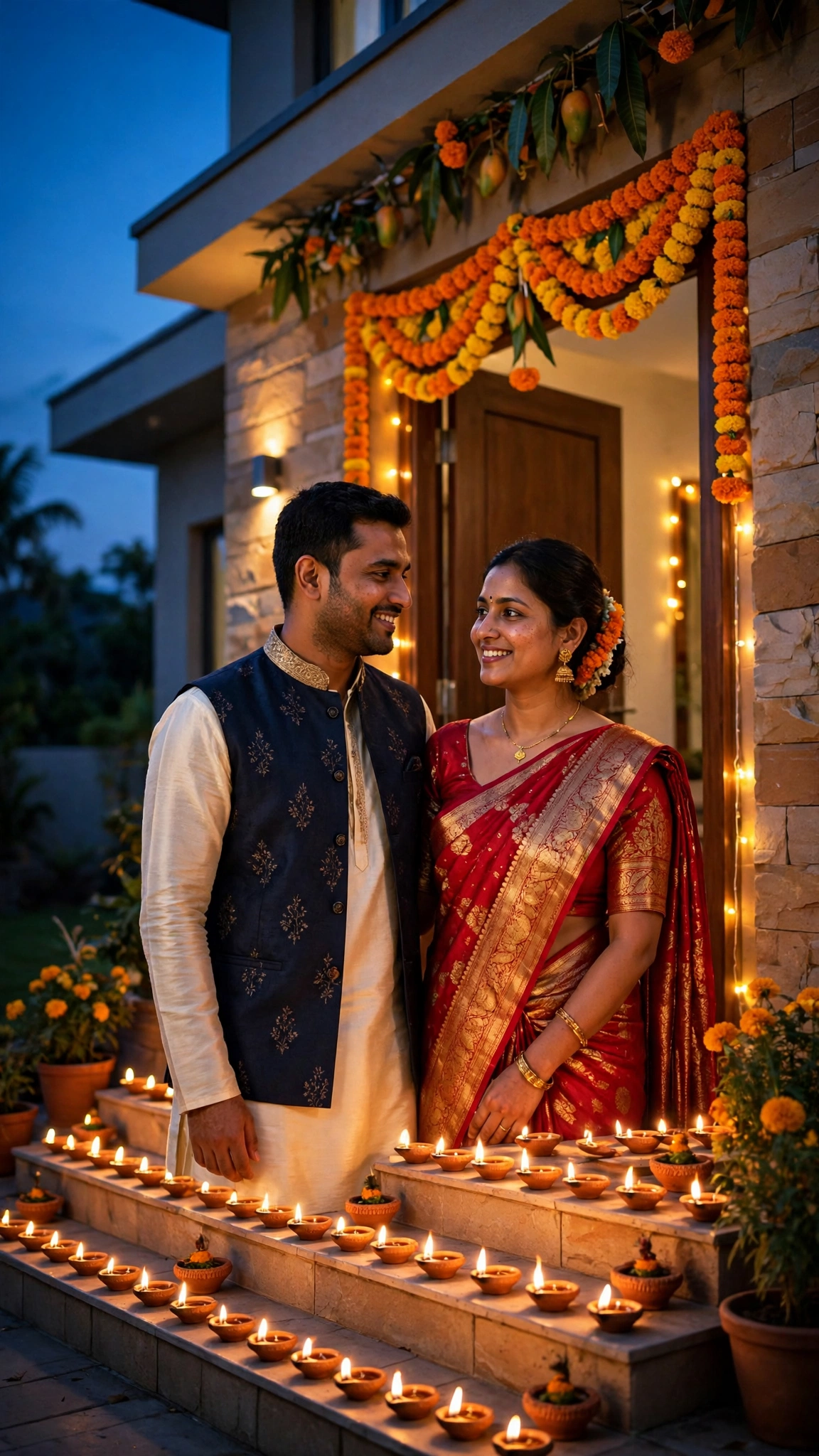
Best for: Evening posts, house exterior photos and the “our new home” announcement.
Customize it: Dusk scenes are dark, so start with a photo where both faces are well lit — a bright starting photo matters more here than in any other prompt.
7. First Milk Boiling in the New Kitchen
The sweetest ritual of the day happens in the kitchen. Milk is boiled in a new vessel on the new stove until it overflows — in the North it is called doodh ubalna, in Tamil homes paal kaachuthal or Paal Pongal — because the overflowing milk symbolises purity, prosperity and abundance entering the home. The milk is then made into kheer or payasam, the first food cooked in the house, offered to the deities and shared as prasad.
AI Prompt:
Edit my uploaded photo into a realistic Griha Pravesh first milk-boiling portrait. Preserve my face, facial features, skin tone, and identity exactly. Place me in a festive saree in a bright new kitchen, boiling milk in a new steel pot on the stove, the milk overflowing slightly, with a small bowl of kheer and flowers nearby and family smiling in the background. Use warm homely light, realistic milk, steam, fabric and skin texture, and a vertical 9:16 composition. Make it look like a candid professional photograph, not an illustration. No text, no logo, no watermark.
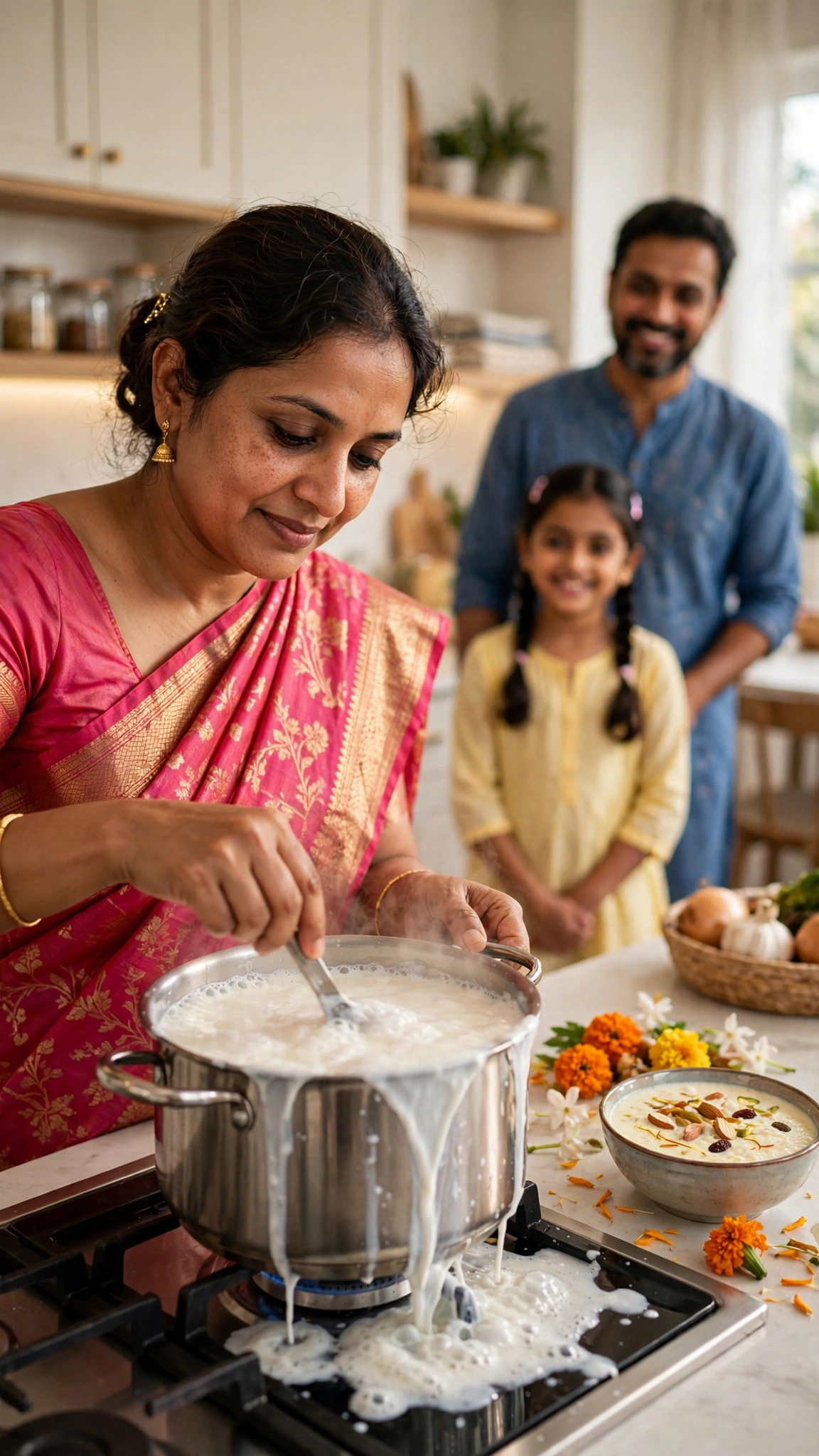
Best for: Kitchen ritual photos, first-cooking posts and sweet, homely DPs.
Customize it: Steam and overflowing milk are hard for AI to render — if the pot looks odd, ask for “gentle steam, milk just beginning to rise” and regenerate.
Tips for Natural-Looking Griha Pravesh Photos
- Use one clear photo. A front-facing photo with even light beats a side profile or a group crop.
- Keep the kalash and coconut low. The kalash is the heart of the Griha Pravesh photo, but too high and it hides your face.
- Let the marigolds do the work. The orange of the toran and the gold of the diyas are the colours of this ceremony; a simple doorway background makes them stand out.
- Check the fire, hands and flames. AI tools sometimes struggle with havan fire, fingers holding a kalash, and diya flames. If anything looks painted or odd, regenerate before posting.
- Stay honest in captions. These are AI-edited photos. If you share one as a real memory, say so, so friends and family are not misled.
Frequently Asked Questions
What is Griha Pravesh?
Griha Pravesh is the Hindu housewarming ceremony performed when a family moves into a new home for the first time. The name comes from Sanskrit — griha means house and pravesh means entry. The ceremony is believed to purify the house, invite prosperity and seek divine blessings, and it is described in ancient texts such as the Matsya Purana.
What are the different types of Griha Pravesh?
According to Vastu Shastra, there are three forms. Apoorva Griha Pravesh is the first entry into a newly constructed home that has never been lived in — the form most people mean when they say Griha Pravesh. Sampoorva is performed when a person re-enters the home after returning from a foreign land or a long absence. Dwandva is performed after the home has been reconstructed or renovated.
What is Griha Pravesh called in different parts of India?
The ceremony has several regional names. In Telugu, Kannada and Malayalam homes it is called Gruhapravesam, in Bengali it is Griho Probesh, in Tamil it is Graha Pravesam, and Tamil families also call it Pudhu Manai Pugu Vizha. The customs vary by region — for example, in South Indian tradition a cow and calf are sometimes brought into the home first, and the coconut is often placed at the threshold rather than broken.
Why is milk boiled during Griha Pravesh?
Boiling milk until it overflows symbolises purity, prosperity, nourishment and abundance. The overflowing milk is seen as a sign that wealth, health and happiness will keep growing in the new home. The milk is then used to make kheer or payasam, the first food cooked in the house, which is offered to the household deities and shared as prasad. In Vastu Shastra the kitchen is governed by Agni, the fire god, so lighting the stove for the first time also invokes Agni’s blessings.
Can I use these prompts in both Gemini and ChatGPT?
Yes. Both tools accept an uploaded photo plus a pasted text prompt, and the wording works in either app, though results vary slightly — so try the same prompt in both if the first result is not right.
Will the AI keep my real face?
That is the goal of the “preserve my face” line in every prompt, and it usually works well with a clear starting photo. It is not perfect every time, so check the result closely, especially around the eyes, smile, and hairline.
Do these prompts cost money?
Gemini and ChatGPT both offer free tiers, but image generation limits change often. Check your app for its current free limits before you start; this article does not promise any free quota.
Real-World Examples and Case Studies
I could not find a published case study of a family using AI photo editing specifically for Griha Pravesh — this is a new use of the tools, and no newspaper, research paper or company report I could verify has documented one. What I can say from the ceremony itself is that the moments in these prompts are the ones families actually photograph: the first entry with the kalash, the coconut at the threshold, the havan, the family portrait in the living room, and the milk boiling in the kitchen. Those are the scenes relatives ask to see on WhatsApp the same evening, and they are the scenes these prompts are built around.
Verified Facts and Data
There are no reliable published statistics I could verify about Griha Pravesh itself — no survey or official dataset counts how many Indian families perform the ceremony each year, so I will not invent a number. What is verifiable is the ceremony’s shape: it is described in the Matsya Purana; Vastu Shastra prescribes three forms (Apoorva, Sampoorva and Dwandva); the kalash, coconut, mango leaves and toran appear in the ceremony across regions; and the milk-boiling ritual, with the milk allowed to overflow as a sign of abundance, is documented in both North and South Indian practice. Those are the facts this article relies on, and they are listed in the sources below.
Final Thoughts
Griha Pravesh photos work best when they stay simple and real: the kalash in your hands, the marigold toran over the door, the rangoli underfoot, the diyas glowing in the evening, and the people you love beside you. Pick the prompt that matches your moment — the kalash and toran entrance for the first entry, the coconut breaking for the threshold, the Vastu Shanti havan for the puja, the family portrait for the living room, the invitation photo for the WhatsApp card, the diya-lit exterior for the evening, or the milk boiling for the first cooking in your new kitchen. Upload a clear photo, paste the prompt in full, and check the fire, hands, diyas and your face before you post.
If you are planning more festive-season photos, our Diwali AI Photo Editing Prompts article covers the festival of lights in the same style, and our Reception AI Photo Editing Prompts article covers wedding portraits.